
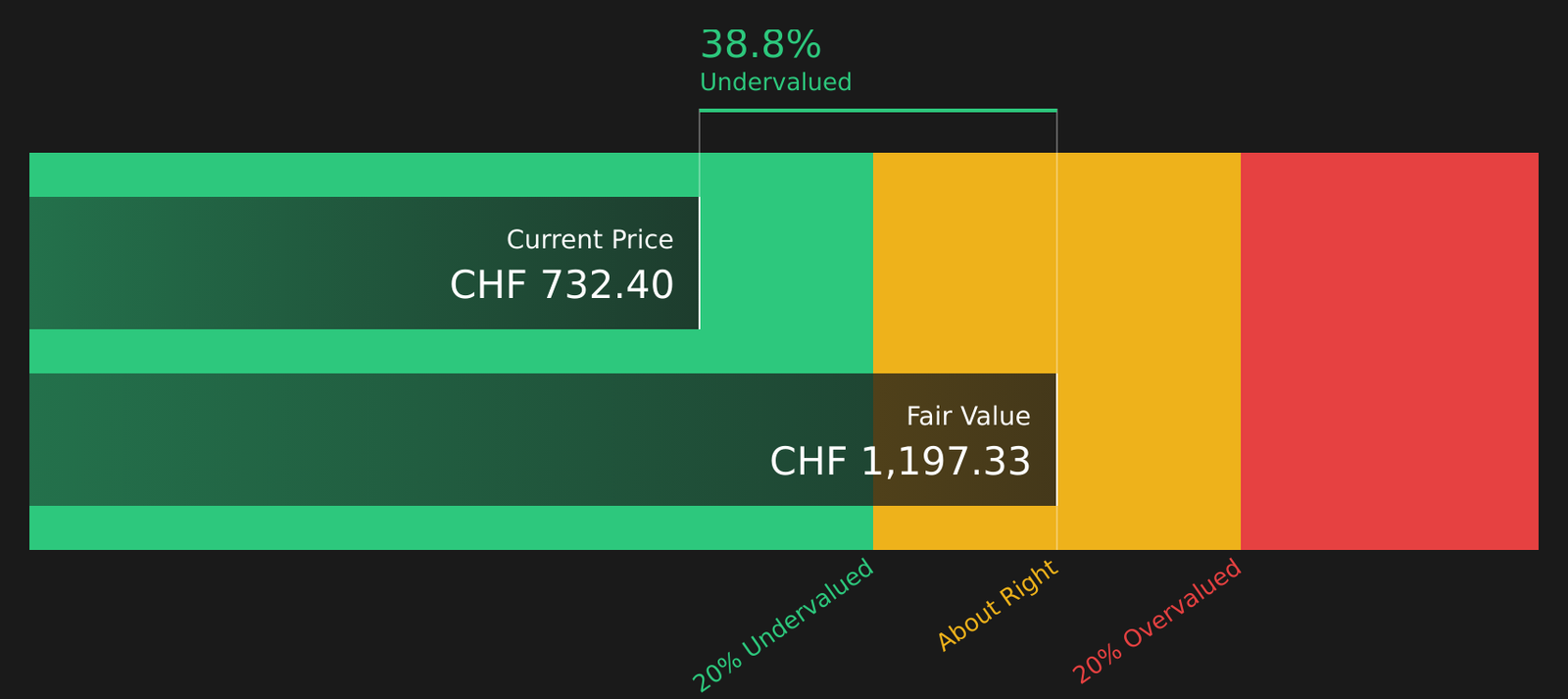
Partners Group Holding (SWX:PGHN) is currently trading at a 38.8% discount to its estimated intrinsic value, sparking debate among investors over whether the stock is significantly undervalued or merely a value trap following a difficult five-year period where shares declined by approximately 44.5%.
Excess Returns Model Signals Undervaluation
The Excess Returns model, which evaluates profit generation above the cost of equity, paints a compelling picture for Partners Group. With a Book Value of CHF84.83 per share and a stable EPS of CHF50.15, the company demonstrates a high return on its equity base. When factoring in a Cost of Equity of CHF4.15 per share, the firm maintains an Excess Return of CHF46.00 per share, underpinned by a robust 57.23% Return on Equity.
These metrics translate into an estimated intrinsic value of CHF1,197 per share. The recent boost in EBITDA margins at Foundation Risk Partners, driven by AI integration, suggests that the market may be underpricing the firm’s future excess returns, leaving the stock appearing undervalued under this specific framework.
P/E Multiple Analysis
Beyond the Excess Returns model, the Price-to-Earnings (P/E) ratio provides further insight into the firm’s market standing. Partners Group currently trades at a P/E of roughly 15.0x, notably lower than the Capital Markets industry average of 16.8x and the peer group average of 18.2x.
When adjusting for margins, scale, and risk profile, the “fair” P/E ratio is estimated at 18.4x. This discrepancy between the current multiple and the model-implied fair value suggests that the market is maintaining a cautious stance, potentially discounting the shares despite the underlying strength of the company’s current earnings.
Market Sentiment and Future Risks
The valuation puzzle is further complicated by divergent community narratives. Investors remain split, with one camp identifying significant upside potential while others highlight the dangers of late-cycle risks. Simply Wall St’s community analysis provides a platform to weigh these competing theories, linking specific fair value estimates to potential catalysts and operational risks.
Ultimately, while both the Excess Returns model and the P/E multiple suggest that Partners Group is undervalued, the market’s current discount may be a reflection of perceived risks rather than a simple mispricing. The path forward depends on the company’s ability to execute its portfolio strategy and efficiency initiatives, which will be critical in convincing the market that its current profitability is sustainable and that the present discount is an opportunity rather than a trap.