The S&P 500 is eyeing record highs this week, bolstered by a robust corporate earnings season and a cooling labor market that has tempered Federal Reserve interest-rate hike expectations following Friday’s surprisingly weak jobs report.
“Bad News is Good News” for Wall Street
Analysts at Citi Research, led by Scott Chronert, have adopted a “bad news is good news” stance regarding the current labor market. This sentiment aligns with Dennis DeBusschere, chief market strategist at 22V Research, who suggests that a “benign slowing” of U.S. economic growth could act as a catalyst for higher stock prices.
The latest nonfarm-payrolls report revealed a loss of 23,000 jobs in July, defying expectations of an 83,000 gain. While employment conditions are easing—evidenced by a lower employment-to-population ratio and slowing nominal wage growth—economic activity remains resilient. For DeBusschere, this cooling effect provides the economy with necessary breathing room to expand before inflation becomes a systemic threat.
Raising the GDP Speed Limit
“This easing labor market dynamic, counterintuitively, raises the implied speed limit for GDP growth,” DeBusschere argues, noting that the threshold could now potentially exceed 2%. By preventing wage-driven inflation, the economy can run hotter without forcing the Federal Reserve to aggressively tighten monetary policy. Consequently, the Fed retains the flexibility to respond to demand shocks with interest rate cuts as long as labor slack increases and wage pressures diminish.
Investors are now looking ahead to Wednesday’s release of the July consumer-price index data to confirm this trend.
The Outlook for Treasury Yields and Equities
Despite the cooling labor market, DeBusschere does not anticipate a significant drop in Treasury yields. He expects 10-year Treasury yields BX:TMUBMUSD10Y to hover around 4.5%, reflecting a firmer long-term growth outlook and a higher equilibrium interest rate, or R*.
This environment—characterized by sustainable growth, easing inflation, and a central bank with room to maneuver—creates a powerful tailwind for equities. DeBusschere anticipates that a more durable expansion will lower equity risk premiums, providing further upside potential for stocks. Additionally, he points to artificial intelligence as a key driver of profitability. His analysis suggests that AI-linked efficiencies are contributing to an average 150 basis-point improvement in corporate margins.
Driven by these factors, DeBusschere projects the S&P 500 SPX could reach 8,500 within the next 12 months, leading him to favor cyclical stocks over defensive alternatives.
Market Movements and Corporate Updates
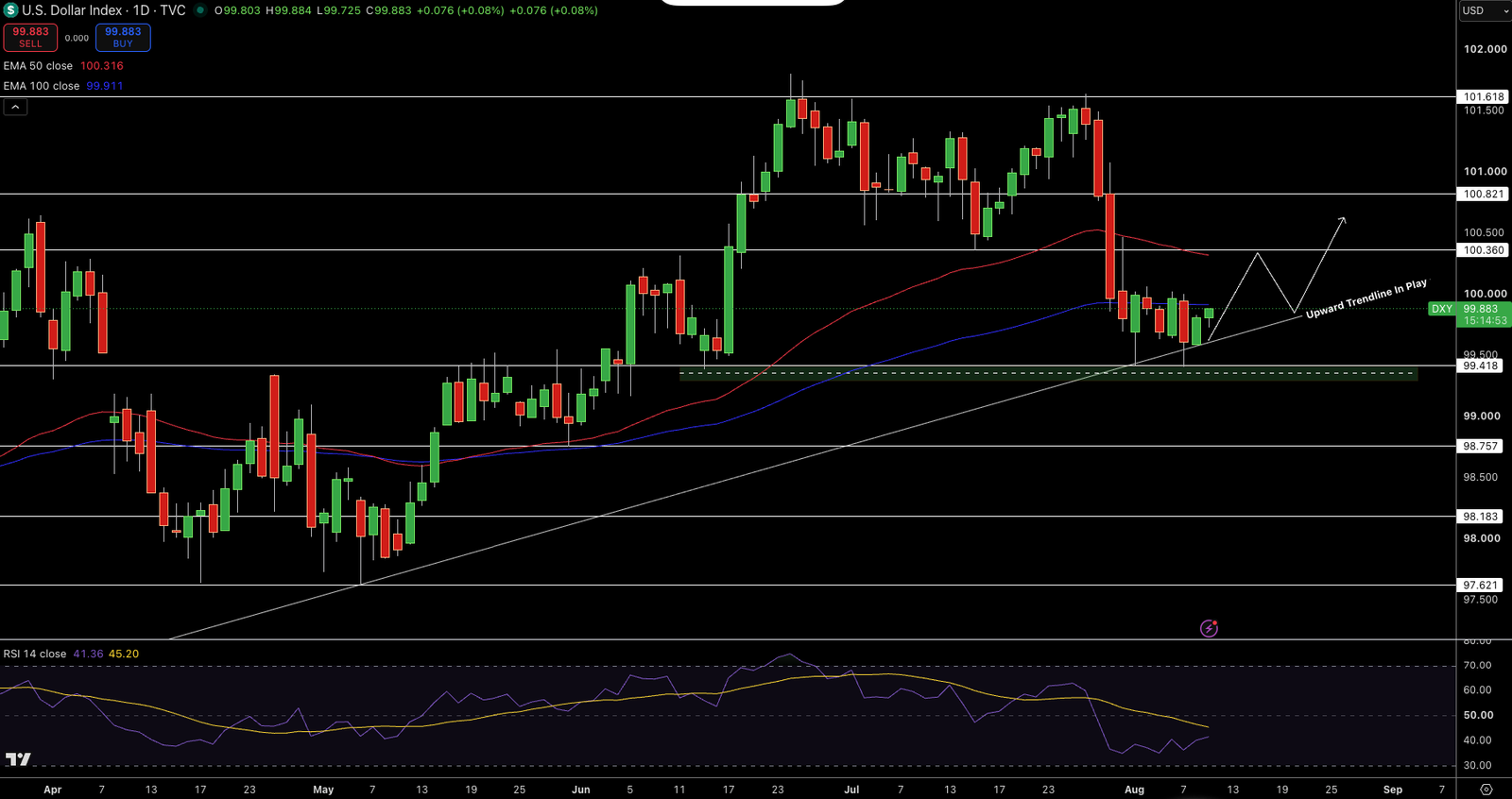
As of the opening bell, U.S. stock indices SPX DJIA COMP are trading slightly lower as Treasury yields BX:TMUBMUSD10Y edge upward. The dollar index DXY has strengthened, while gold futures GC00 are trading near $4,392 an ounce.
In corporate news, Berkshire Hathaway BRK.B reported that its second-quarter profit more than doubled, fueled by successful stock investments. Meanwhile, oil prices CL.1 BRN00 rose on Monday amid concerns regarding a stalled U.S.-Iran deal that would have reopened the Strait of Hormuz. Intel shares INTC are trending downward following the company’s announcement of a $15 billion stock sale, and Apple AAPL shares faced a downgrade to “underperform” by Jefferies analysts.
Regarding precious metals, Jonathan Krinsky, technical strategist at BTIG, notes that while gold has rallied from recent lows, it is approaching strong resistance in the $4,400 to $4,500-an-ounce range. This zone coincides with the 200-day moving average and the downtrend from previous all-time highs.