
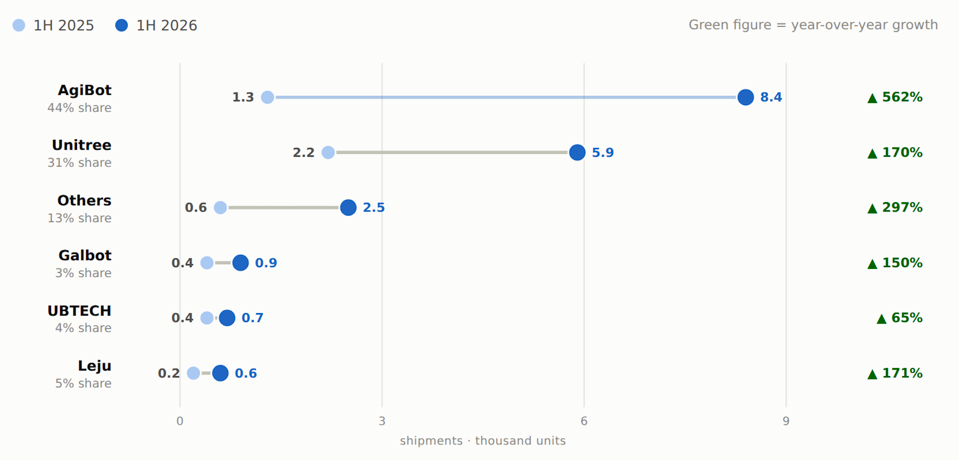
Global humanoid robot shipments surged 272% year-over-year in the first half of 2026, reaching 19,100 units, according to a report by Smart Analytics Global. With projections hitting 60,000 units by year-end and a target of half a million by 2030, the industry is scaling rapidly, yet Chinese manufacturers currently control 97% of global shipments and 85% of total demand.
The Rise of Chinese Market Leaders
The market landscape has shifted dramatically, with Shanghai-based startup AgiBot emerging as the new frontrunner. AgiBot shipped 8,400 units in the first half of 2026—capturing 44% of the global market—marking a massive 562% increase from the previous year. This performance pushed AgiBot ahead of former leader Unitree, which secured a 31% market share with 5,900 units. Together, these two firms now dominate three-quarters of the global humanoid robot population.
While Unitree has focused on its popular, compact G1 model for research and viral media, AgiBot has pursued a diversified strategy. Its lineup includes full-size bipedal A-series robots, X-series units, and wheeled G-series models designed specifically for industrial and warehouse environments. AgiBot is already expanding into the U.K. and Germany, though its potential U.S. expansion remains stalled due to regulatory hurdles.
From Viral Demos to Industrial Utility
A critical trend highlighted by Smart Analytics Global is the transition from novelty to utility. Industrial and commercial applications now account for over 70% of shipments, up from 50% just a year ago. As these robots move into assembly lines and logistics hubs, market revenue is expected to climb from $1.6 billion in 2026 to $3 billion in 2027.
The U.S. Regulatory Response
In late July, the Federal Communications Commission (FCC) issued a ban on new imports of foreign-made humanoid and quadruped robots, citing national security and cybersecurity risks. By specifically naming Unitree and AgiBot, the U.S. government is attempting to curb the integration of foreign-controlled hardware—equipped with cameras and sensors—into American infrastructure. While this ban does not affect existing units, it creates a significant barrier for future Chinese market entry in the United States.
Why the Sales Gap Isn’t a Technology Gap
Despite China’s overwhelming lead in current shipment volume, the dominance of Chinese firms does not necessarily signal a defeat for American and European innovation. U.S. companies like Figure, Boston Dynamics, Agility Robotics, Apptronik, and 1X are prioritizing product reliability and technical capability over raw volume.
Scaling too early carries the risk of flooding the market with unreliable machines, which can erode brand trust and waste capital. American and European developers appear to be pursuing a “Goldilocks” strategy: waiting until their robots can perform complex, economically viable tasks before initiating mass production. While China currently holds an advantage in deployment data, the race to build the most capable humanoid robot remains highly competitive, and the FCC’s recent actions provide domestic manufacturers with additional time to refine their technology and prepare for large-scale deployment.