
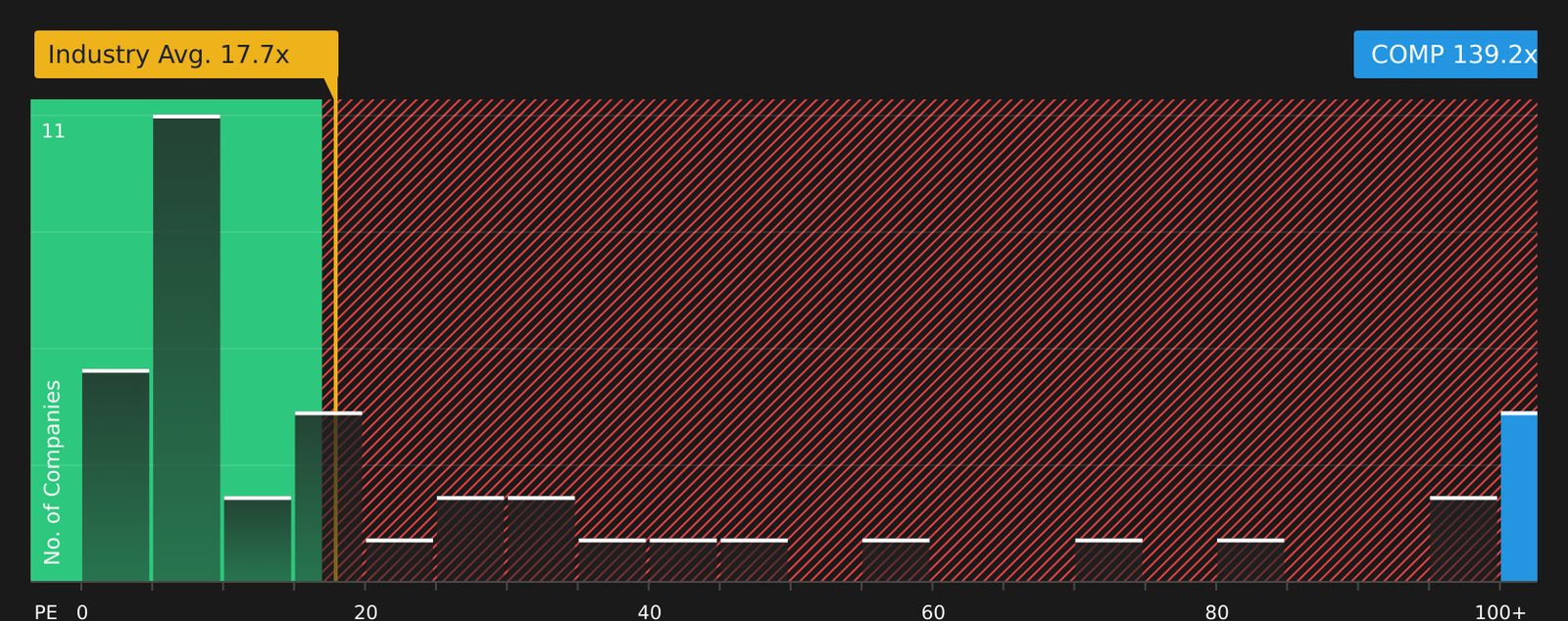
Compass (COMP) has delivered an impressive 49.8% return over the past year, but its current valuation suggests the shares may now be trading at a significant premium, leaving investors to question if further upside remains.
Evaluating the Price-to-Earnings Premium
The core issue for potential investors is determining whether the current share price fully accounts for recent positive earnings reports or if the market remains overly cautious. A standard metric for this assessment is the P/E ratio, which reveals how much investors are paying for every dollar of Compass’s earnings.
Currently, Compass trades at a P/E ratio of approximately 139.2x. This figure stands in stark contrast to the broader real estate industry average of 17.7x and the peer group average of 92.1x. When applying a valuation model that accounts for the company’s specific growth profile, margins, size, and risk, a “fair” P/E ratio for Compass sits closer to 43.3x. While this model applies a heavy penalty for the company’s risk profile, the wide gap serves as a clear warning flag that the stock appears expensive based on current earnings.
Market Optimism vs. Financial Reality
Despite a strong Q2 earnings beat and optimistic forward guidance, the elevated P/E multiple indicates that the market has already priced in a high level of growth. Investors are effectively paying a premium today for future performance.
To justify this valuation, Compass must demonstrate sustained progress in earnings and margins. If the company fails to meet these high expectations—or if housing market conditions deteriorate—the stock’s valuation could face pressure to realign with its industry peers.
Analyzing Future Growth Paths
The path forward for Compass depends on how its growth, profitability, and risk factors evolve. While the current price reflects significant optimism, further gains are not impossible; however, they would require the company to consistently deliver on its operational targets to make the current, elevated multiple sustainable.
For investors looking deeper into the numbers, detailed valuation breakdowns and community-driven narratives—which explore various scenarios for growth and margin expansion—provide additional context on how the stock may be perceived relative to its intrinsic value.