Rio Tinto Group (LSE:RIO) faces a valuation paradox as its stock price sits significantly above its Discounted Cash Flow (DCF) intrinsic value, despite trading at a discount when measured by earnings-based multiples following an 88.9% return over the past three years.
The DCF Valuation Gap
The Discounted Cash Flow (DCF) approach evaluates a company based on the present value of its expected future cash flows. For Rio Tinto, the model utilizes a trailing twelve-month free cash flow of approximately US$7.4 billion, factoring in near-term growth projections before transitioning to more conservative long-term estimates.
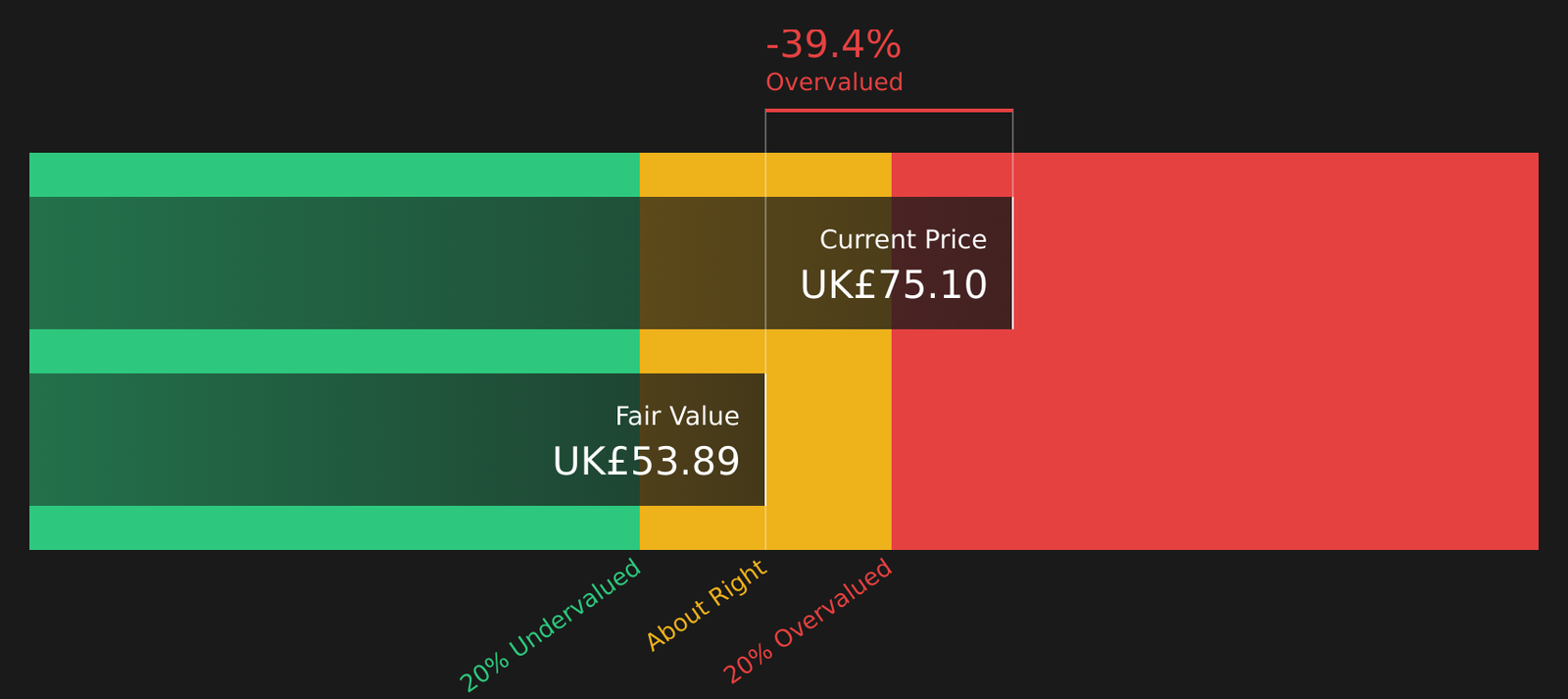
Based on these projections, the DCF model estimates an intrinsic value of £53.89 per share. When measured against current market prices, this suggests the stock may be overvalued by approximately 39.4%. Despite a robust performance in copper earnings and improved free cash flow this year, the market valuation remains detached from the levels suggested by this cash flow-based methodology.
Earnings Multiples Paint a Different Picture
While the DCF model signals caution, the Price-to-Earnings (P/E) ratio offers a contrasting perspective. Rio Tinto currently trades at a P/E of 13.6x, trailing the Metals and Mining industry average of 14.5x and significantly lower than the broader peer group average of 31.2x.
When compared to a tailored “fair” P/E estimate of 19.2x—which accounts for the company’s specific earnings profile, size, and sector-related risks—Rio Tinto appears to be trading at a discount. This discrepancy persists even after accounting for recent earnings contributions from copper and other operational segments.
Market Sentiment and Future Outlook
The divergence between the DCF results and P/E multiples reflects the broader market debate surrounding Rio Tinto. Investors remain split: one faction emphasizes the long-term potential of electrification and green energy transition, while others remain focused on the inherent risks associated with iron ore dependency and rising operational costs.
Ultimately, the investment case for Rio Tinto hinges on whether the company’s capital-heavy projects can generate sufficiently reliable future cash flows to justify current earnings premiums. As the valuation metrics remain mixed, the central question for shareholders is whether the market is currently pricing in future growth or if the recent rally has outpaced the underlying fundamental reality.