
Green Plains (GPRE) shares currently trade at approximately US$15.09, maintaining an attractive valuation despite delivering a robust 70.8% return over the past twelve months, raising questions about whether the market has fully priced in its growth potential.
Evaluating Green Plains’ Market Position
Investors are currently scrutinizing whether Green Plains still offers a clear margin of safety following its significant annual rally. While a 70.8% return typically signals a mature growth phase, the company’s valuation metrics suggest there may still be room for upside when compared to broader industry standards.
P/E Ratio Analysis: A Value Play?
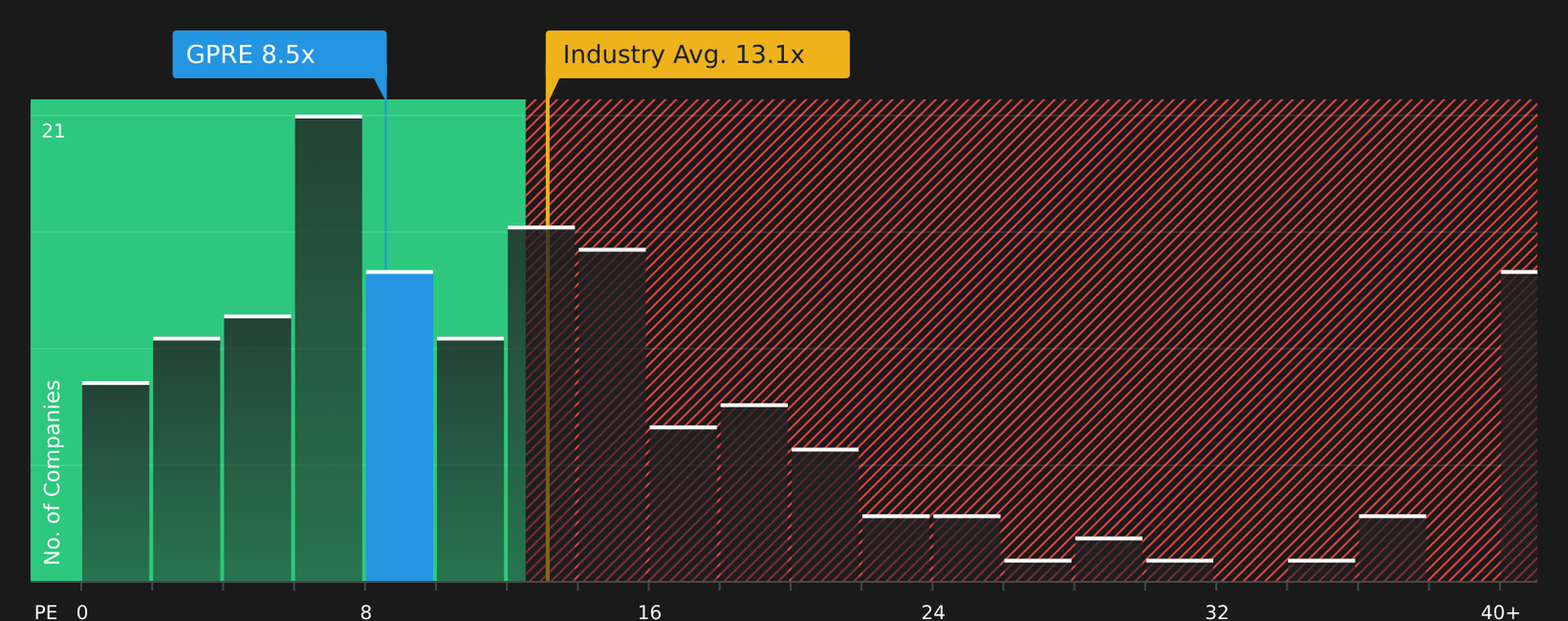
A primary indicator of the company’s current standing is its price-to-earnings (P/E) ratio. Green Plains is currently trading at a P/E of approximately 8.5x. This figure sits notably lower than the Oil and Gas industry average of roughly 13.1x and significantly below the peer group average of 20.8x. Based on these headline numbers, the stock appears to be priced more conservatively than many of its direct competitors.
The Tailored Fair Value Benchmark
When applying a more nuanced framework—one that accounts for the company’s specific size, risk profile, and earnings characteristics—a fair P/E ratio for Green Plains emerges closer to 10.3x. Against this benchmark, the current 8.5x multiple suggests the market is applying a discount to the stock. This gap indicates that Green Plains remains attractively valued on an earnings basis, even after its recent share price appreciation.
Market Sentiment and Future Outlook
Investor sentiment regarding Green Plains remains divided. One camp focuses on the company’s earnings potential supported by current industry policies, while the other remains cautious, citing long-term demand risks associated with the ethanol market.
The core question for investors moving forward is whether Green Plains can successfully transition its business model into consistent, long-term earnings and cash flow. The current discount may reflect market caution regarding policy shifts and long-term demand, yet the fundamental valuation metrics suggest the stock is far from being overstretched.