
Categoria: economy

  • Crude Oil Surges Past $84 Amid Rising Geopolitical Fears

    Crude Oil Surges Past $84 Amid Rising Geopolitical Fears

    Crude oil prices spiked overnight, with WTI futures climbing to $84.61 as escalating geopolitical tensions between the U.S. and Iran, alongside fears of a broader conflict involving Russia and North Korea, rattled global markets. Following a 5% gain on Monday, the spot-month WTI contract (CLU26) surged an additional $2.48, or 3%, as hopes for a deal regarding the Strait of Hormuz continue to evaporate.

    Corn Market Remains Subdued

    The corn market saw muted activity early Tuesday. The December issue (ZCZ26) fluctuated within a narrow 3.0-cent range, trading fewer than 20,000 contracts and sitting 1.5 cents higher in pre-dawn action. While rainfall is moving across Iowa and expected to intensify east of the Mississippi, the impact on harvest remains limited to the U.S. Southeast. Market data indicates that “Watson” is liquidating September longs without rolling into December, while the National Corn Index slipped to $4.11.

    Soybeans Await Market Direction

    Soybean markets remained largely stagnant, with the November contract (ZSX26) oscillating between fractional gains and losses on low volume. Despite a 1.5% rally in diesel fuel (HOU26) and slight gains in soybean oil (ZLZ26), there were no clear signs of major buying activity. Weather forecasts for August 16–20 suggest above-normal temperatures and precipitation across the U.S. Plains and Midwest, maintaining the current outlook for the new crop.

    Wheat Prices Climb on Geopolitical Uncertainty

    Wheat futures traded in the green on Tuesday, potentially driven by the latest headlines from the Russia-Ukraine conflict. Despite the long-standing nature of the war, market participants are closely watching the net-short futures position held by “Watson” in the Soft Red Winter (SRW) market. Recent data shows a significant increase in short positions, though some short-covering has occurred during the current positioning week. The December SRW (ZWZ26) was up 5.75 cents, while December HRW (KEZ26) rose 7.0 cents in early trading.

  • US Dollar Forecast: Will July CPI Data Trigger a DXY Rally?

    US Dollar Forecast: Will July CPI Data Trigger a DXY Rally?

    The U.S. Dollar Index (DXY) faces a pivotal moment this week as investors await July’s Consumer Price Index (CPI) data, scheduled for release this Wednesday. This report will serve as the primary catalyst for the Federal Reserve’s next move, determining whether the central bank maintains its current rate pause or resumes aggressive tightening in September.

    Inflation Data and Fed Policy Outlook

    Economists are projecting a 0.2% month-on-month increase in core CPI. Should the data align with these forecasts, it would signal that inflation is steadily moving toward the Fed’s 2% target. For context, the Fed’s preferred core inflation measure stood at 3.3% in June, with an annual increase of 2.8%.

    Interest rate expectations have become increasingly volatile. Persistent inflation and regional energy shocks are testing the Fed’s recent decision to hold rates steady, despite internal dissent. Furthermore, political tensions—specifically attempts to challenge the Fed’s autonomy—are adding a layer of fundamental risk to the dollar’s outlook.

    Currency Markets: Euro and Sterling Dynamics

    The Euro is navigating significant uncertainty. Recent reports suggest the Japanese Yen was bolstered by U.S. Treasury dollar-selling, raising questions regarding currency coordination and whether the Treasury is balancing support for the dollar while mitigating pressure on bond markets. Consequently, the European Central Bank (ECB) is expected to maintain its current policy trajectory.

    Meanwhile, the British Pound is bracing for second-quarter UK GDP data. Analysts expect growth of approximately 0.4% for Q2, following a 0.6% expansion in Q1. Despite ongoing supply chain disruptions and geopolitical friction involving Iran, the UK economy has shown resilience. Stronger-than-expected figures would likely embolden the Bank of England to sharpen its focus on inflation risks, influencing the broader performance of the USD, EUR, and GBP.

    DXY Technical Analysis: Bears Still in Control

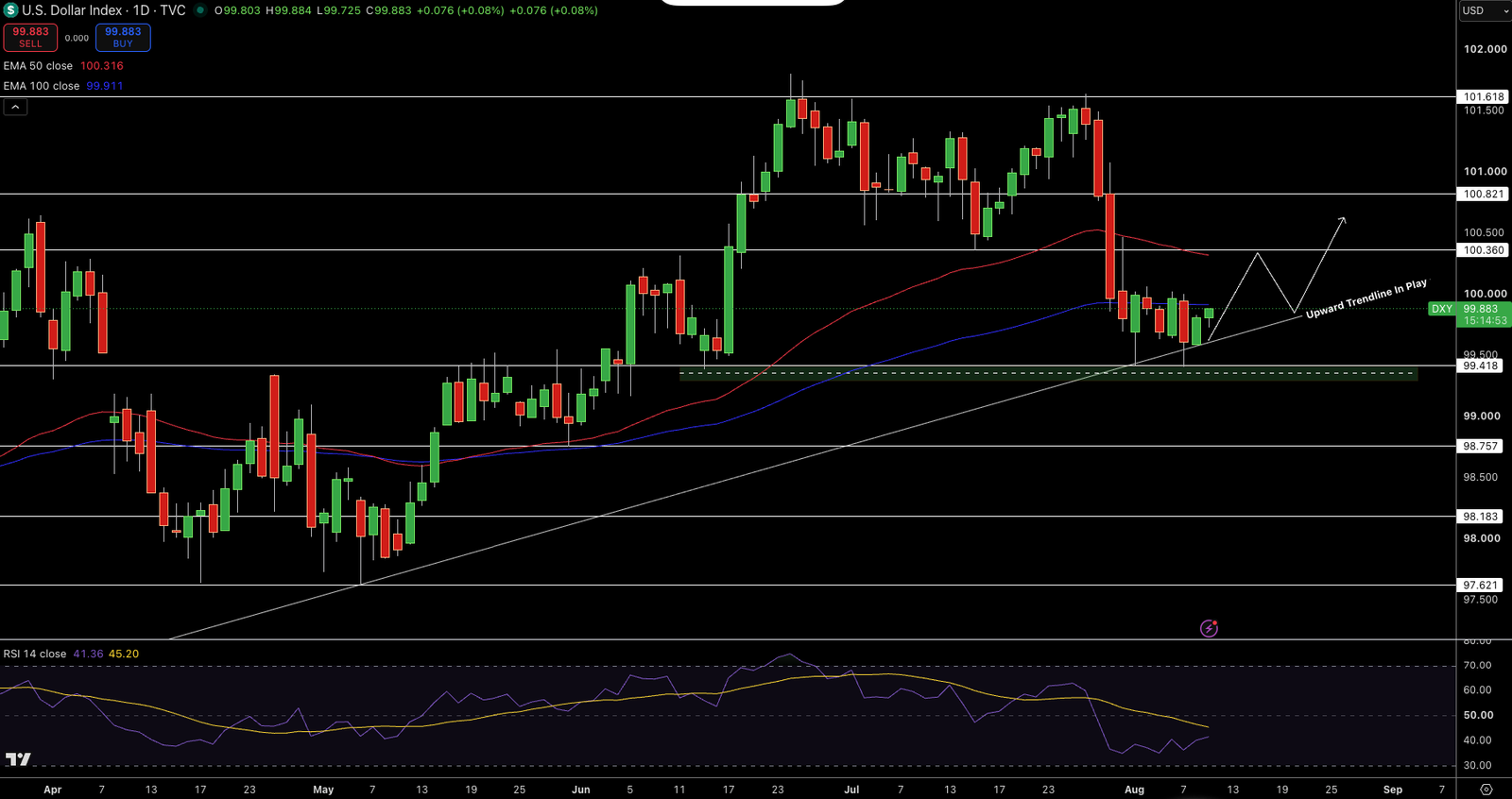
    The US Dollar Index is currently trading at $99.88. While the index holds above a rising trendline and horizontal support at $99.42, it remains trapped below the 50-day EMA ($100.32) and the 100-day EMA ($99.91), indicating that bearish sentiment persists. Current buying pressure is insufficient to confirm a bullish reversal.

    The Relative Strength Index (RSI) sits at 41, suggesting that while extreme selling pressure has eased, the index has yet to reclaim neutral territory. Resistance levels are pegged at $100.36, $100.82, and $101.62. Should the index break below $99.42, further support is anticipated at $98.76 and $98.18.

    GBP/USD and EUR/USD Trends

    The GBP/USD pair is trading near $1.3499, maintaining a bullish structure above its rising trendline and moving averages ($1.3456 and $1.3427). With an RSI of 58, the pair shows healthy momentum. A decisive break above $1.3516 could trigger a move toward $1.3559, while support remains steady at $1.3437.

    Conversely, EUR/USD is trading at $1.1534, struggling against a long-term falling trendline. The pair is positioned below the 50-day MA ($1.1496), and buyers appear to be losing momentum near the $1.1556 resistance level. While the RSI at 58 suggests potential for growth, a clean breakout above resistance is required to shift the trend. Immediate support for the Euro stands at $1.1455, with a critical floor at $1.1357.

  • Unemployment Hits Record Lows: Is the Job Market Actually Weak?

    Unemployment Hits Record Lows: Is the Job Market Actually Weak?

    The U.S. labor market has officially entered the history books, maintaining an unemployment rate of 4.5% or lower for 57 consecutive months—the longest streak since 1970—yet analysts warn that this historic low does not necessarily signal a robust economy.

    A Record-Breaking Streak Under Scrutiny

    In July, the unemployment rate edged down from 4.2% to 4.1%, reaching its lowest point in over a year. While this milestone underscores a sustained period of low joblessness, the underlying data reveals a more complex reality. Job creation has noticeably faltered since 2025 as employers exercise caution in their hiring practices.

    Why Hiring Has Stalled

    Corporate expansion has hit a plateau over the past year. Businesses are pulling back on recruitment, citing significant macroeconomic uncertainties, including international trade tariffs, ongoing geopolitical tensions in Iran, and the rapid, disruptive integration of artificial intelligence across various industries.

    The Hidden Reality Behind the Numbers

    The primary reason the unemployment rate has not climbed despite sluggish hiring is a decline in workforce participation; fewer people are actively seeking employment. This phenomenon is reflected in the Conference Board’s consumer confidence survey, which shows that the general public remains largely pessimistic about the current ease of finding new work.

    What This Means for the Federal Reserve

    Despite these headwinds, the persistently low unemployment rate provides the Federal Reserve with a strategic advantage. It allows policymakers to shift their primary focus toward the other half of their dual mandate: controlling inflation to ensure stable consumer prices.

    Interest Rate Forecasts and Market Sentiment

    Financial markets currently see no indication that the Fed will be forced to cut interest rates to stimulate the labor market this year. Instead, data from the CME Group’s FedWatch tool suggests an 80% probability that the Federal Reserve will raise the fed funds rate by at least a quarter-point before year-end to combat persistent inflation.

    Supply vs. Demand: An Economic Perspective

    “From the Fed’s perspective, the labor market is at full employment and the economy cannot create jobs from people who are not here,” noted John Ryding, chief economic advisor at Brean Capital. Ryding further emphasized that the current report is not a reflection of weak economic demand, but rather a direct result of a structural shortage in the labor supply.

  • Forget Big Oil: This Midstream Stock Offers Higher Yields

    Forget Big Oil: This Midstream Stock Offers Higher Yields

    Enterprise Products Partners (NYSE: EPD) has emerged as a superior alternative to integrated energy giants like Chevron and ExxonMobil for income-focused investors, offering a significantly higher dividend yield and exceptional cash flow stability.

    The Midstream Advantage Over Upstream Giants

    While industry titans Chevron and ExxonMobil are celebrated for their decades-long dividend growth streaks, they often fall short in providing competitive yields. Unlike upstream oil drillers, which remain highly susceptible to volatile commodity price swings, Enterprise Products Partners functions as the “highway system” for North American energy.

    The company maintains a massive infrastructure footprint, boasting 50,000 miles of pipelines, 21 deep-water docks, and 300 million barrels of liquid storage capacity. This physical dominance creates a formidable barrier to entry and a reliable foundation for revenue.

    Business Model Built for Stability

    Enterprise mitigates market risk through a strategic fee-based business model. Approximately 80% of its gross operating margin is derived from volume-based fees rather than the fluctuating spot prices of oil and gas. Furthermore, nearly 90% of its long-term contracts include built-in escalation provisions to hedge against inflationary pressures.

    This structural resilience was on full display in the second quarter, where the firm reported record EBITDA of $2.8 billion and earnings per share of $0.84, both surpassing consensus estimates.

    Operational Growth and Dividend Strength

    The company’s recent performance was fueled by a surge in demand for U.S. energy. Total pipeline-equivalent volumes increased by 8% to 14.7 million barrels per day (MMBPD), while marine terminal volumes saw a dramatic 33% spike, reaching 2.8 MMBPD. Enterprise continues to expand its footprint with new processing facilities in the Permian Basin, a critical engine for its ongoing growth.

    Currently, Enterprise Products Partners offers a 5.9% dividend yield, substantially outperforming Chevron’s 3.7% and ExxonMobil’s 2.6%. This payout is backed by a 28-year streak of consecutive distribution increases.

    Understanding the MLP Structure

    As a master limited partnership (MLP), Enterprise operates as a pass-through entity that avoids corporate income tax, distributing profits directly to unitholders. While this structure offers significant tax-deferral advantages, investors should be aware that the company issues a Schedule K-1 for tax purposes, which necessitates a more detailed approach during tax filing season.

  • Oil Prices Hit $92.54: Why Your Gas Bill Is Surging

    Oil Prices Hit $92.54: Why Your Gas Bill Is Surging

    As of 6:20 a.m. ET on August 11, 2026, Brent crude oil is trading at $92.54 per barrel, marking a sharp $4.99 increase from yesterday and a significant $25.38 jump compared to this time last year.

    The Volatile Drivers of Oil Markets

    Market direction remains notoriously difficult to predict, as it is tethered to the fundamental forces of supply and demand. Heightened geopolitical tensions, the looming threat of recession, and global conflict remain the primary catalysts that can shift pricing trends almost instantaneously.

    From Crude Barrel to Gas Pump

    While crude oil typically accounts for over half of the price you pay at the pump, the final cost is a cumulative reflection of the entire supply chain. This includes refining costs, wholesale distribution, taxation, and local station markups.

    Consumers often experience the “rockets and feathers” effect: gas prices climb rapidly when oil spikes, but descend with frustrating sluggishness when crude costs fall.

    Strategic Reserves and Economic Protection

    To mitigate supply shocks, the U.S. maintains the Strategic Petroleum Reserve. This emergency stockpile serves as a buffer during crises—such as war, natural disasters, or severe trade sanctions—to ensure that essential services, public transit, and critical industries remain operational. It is a tactical tool for short-term stability rather than a permanent solution to long-term energy imbalances.

    Interconnected Energy Markets

    Oil and natural gas prices are deeply linked. When oil becomes significantly more expensive, industries often pivot to natural gas for specific operational needs, which in turn drives up demand and prices for natural gas as well.

    Understanding the Brent Benchmark

    Global oil performance is primarily measured through two benchmarks, with Brent serving as the international standard. Because it prices a vast majority of the world’s traded crude, it is the preferred metric for historical trend analysis. Even the U.S. Energy Information Administration has adopted Brent as its primary reference for the Annual Energy Outlook.

    Historical data reveals that oil prices are rarely stable, having endured drastic fluctuations tied to global recessions, periods of oversupply—or “gluts”—and supply cuts triggered by international conflict.

    Frequently Asked Questions

    What determines the price of oil?

    Beyond basic supply and demand, geopolitical news and OPEC+ production decisions are critical influencers. In the U.S., domestic policy plays a major role; for instance, the 2025 decision by the Trump administration to reopen over 1.5 million acres of the Arctic National Wildlife Refuge for leasing marked a significant shift from previous policies aimed at limiting Arctic drilling.

    How frequently do prices shift?

    Oil prices are in a constant state of flux while futures markets are active. These markets function as continuous auctions where contracts for future delivery are traded, ensuring that the price reflects the latest market sentiment in real-time.

    The Role of U.S. Shale

    Shale rock, which holds vast deposits of oil and gas, acts as a crucial lever for energy supply. Increased access to U.S. shale reserves helps stabilize the market by providing a domestic buffer, which can prevent extreme price spikes during global supply shortages.

    Economic Impact and Inflation

    Higher oil prices act as an inflationary force, increasing the cost of both energy utilities and the logistics of consumer goods. When fuel costs rise, the price of transporting goods from farms and warehouses to retail shelves increases, ultimately forcing higher prices onto the consumer at the checkout counter.

  • Wall Street Futures Edge Up Ahead of Crucial Inflation Data

    Wall Street Futures Edge Up Ahead of Crucial Inflation Data

    U.S. stock futures are trending slightly higher this Tuesday, signaling a potential recovery after major indices faced a volatile, marginally lower close during Monday’s trading session.

    Market Sentiment and Oil Price Fluctuations

    Investor sentiment received a boost as crude oil prices retreated significantly from their earlier peaks. U.S. crude futures are currently trading up approximately 0.4%, cooling down from a 3% surge earlier in the day caused by uncertainty surrounding negotiations over the reopening of the Strait of Hormuz.

    Investors Brace for Critical Inflation Reports

    Despite the optimistic tone in the futures market, traders remain cautious as they await key U.S. inflation data later this week. The Labor Department is slated to release consumer inflation figures on Wednesday, followed by producer inflation data on Thursday.

    These reports carry heightened importance following Friday’s unexpected dip in U.S. employment figures. Investors are currently weighing how this combination of labor market performance and upcoming inflation data will influence the Federal Reserve’s interest-rate trajectory.

    “US equities are hovering near record highs, but the next leg of the rally will depend on Wednesday’s US inflation report,” notes Daniela Hathorn, Senior Market Analyst at Capital.com.

    “After another strong earnings season, particularly among the technology giants, investors have become increasingly comfortable with the idea that the economy can continue expanding without forcing the Federal Reserve into further policy tightening,” Hathorn added. “Whether that optimism proves justified now hinges on the inflation data.”

    Reflecting on Monday’s Market Performance

    U.S. stocks struggled to find a clear path on Monday, following a week of robust gains. The Dow Jones Industrial Average fell 60.95 points (0.1%) to 53,975.98, the Nasdaq Composite dropped 85.26 points (0.3%) to 26,605.36, and the S&P 500 slipped 4.53 points (0.1%) to 7,753.11.

    This subdued session followed a record closing high for the S&P 500 on Friday, prompting a natural reassessment of the market’s recent rapid advance.

    Geopolitical Tensions and Sector Shifts

    Developments in the Middle East continue to be a primary driver of market sentiment. While reports suggest Iran and Oman are nearing an agreement regarding the Strait of Hormuz, Tehran remains resistant to direct negotiations with the United States.

    Iran has signaled that the vital waterway will remain restricted unless Washington meets specific conditions, dampening hopes for a swift normalization of global energy flows. This tension led to a sharp rise in oil prices on Monday, fueling energy stocks; U.S. crude futures jumped nearly 5%, the Philadelphia Oil Service Index rose 5.8%, and the NYSE Arca Oil Index gained 5.3%.

    Beneath the surface of the broader market, sector divergence was evident. Software stocks saw strong performance, with the Dow Jones U.S. Software Index climbing 1.9%. Conversely, airline stocks faced heavy pressure due to rising fuel costs, with the NYSE Arca Airline Index plunging 4.4%. Semiconductor stocks also struggled, dragging the Philadelphia Semiconductor Index down by 2.9%.

    With futures now leaning positive, the market’s focus remains firmly fixed on Wednesday’s inflation data, which could solidify or challenge the current interest-rate outlook supporting the market’s record-level valuations.

  • Brazil Central Bank: Demand Still Drives Inflation

    Brazil Central Bank: Demand Still Drives Inflation

    Brazil’s central bank confirmed on Tuesday that while high interest rates are beginning to drag on economic activity, persistent demand-side pressures keep inflation high, necessitating a continued restrictive monetary policy.

    Monetary Policy Strategy

    The minutes from the bank’s latest policy meeting—which saw a fourth consecutive 25-basis-point rate cut, bringing the Selic rate to 14.00%—revealed a more optimistic outlook on growth and inflation. However, policymakers stopped short of signaling the future trajectory of the current easing cycle.

    “The Committee will continue to incorporate new information and monitor developments in the scenario in order to keep monetary policy adequately restrictive to ensure convergence to the inflation target,” the bank stated.

    Monitoring Global and Domestic Risks

    Board members emphasized the importance of tracking potential second-round inflation effects stemming from supply shocks. They noted the need for decisive action should these pressures materialize, specifically refining their previous focus on the inflationary impacts linked to the U.S.-Israel and Iran conflict.

    Economic Cooling and Inflation Targets

    Regarding domestic economic activity, the central bank observed a clear deceleration between the first and second quarters. This slowdown, which spans both supply and demand components of aggregate output, is viewed as a vital component in steering inflation back toward the 3% target.

    The minutes also highlighted a positive shift compared to June, noting a slowdown in both headline and underlying inflation measures, contrasting with earlier concerns regarding accelerating price pressures.

    Addressing Market Expectations

    Policymakers addressed the rising long-term inflation expectations, a persistent point of concern for the committee. While they did not specify the exact drivers behind this deterioration, they confirmed they are “closely monitoring” the situation.

    “Perseverance, determination, and serenity in the conduct of monetary policy will contribute to the reanchoring of expectations, which is crucial for the convergence of inflation to the target at a lower cost,” the central bank concluded.

  • Supermicro Revenue Warning: High Backlog vs. Growth Concerns

    Supermicro Revenue Warning: High Backlog vs. Growth Concerns

    Super Micro Computer Inc. recently issued a cautionary business update, signaling that quarterly revenue may land at the lower end of its previously projected $11 billion to $12.5 billion range. Despite this tempered revenue outlook, the company reported a massive surge in demand, with new orders exceeding $60 billion during the period, pointing toward a record-breaking backlog that underscores significant market interest in its technology.

    Market Sentiment Remains Cautious

    The broader financial landscape remains in a state of hesitation following a sluggish start to the trading week. Stock futures tied to the Dow Jones Industrial Average showed minimal movement, trading fractionally lower as investors weigh mixed economic signals and individual corporate performance updates.

    Oil Prices and Index Performance

    Beyond the tech sector, the energy market saw a notable shift as oil prices pulled back from recent highs. This retreat in energy costs, combined with the cautious posture of major stock indexes, suggests that market participants are currently adopting a “wait-and-see” approach while navigating the complexities of the current fiscal quarter.

    Read the original article on Investopedia

  • Pay Cuts for Stability: Why Workers Are Choosing Security

    Pay Cuts for Stability: Why Workers Are Choosing Security

    More than half of U.S. workers (54%) are now willing to accept a pay cut to guarantee job security, according to the Monster 2026 Job Security Report, which surveyed 1,020 employees on July 17. This shift marks a stark contrast to 2024, when a Ford Trends survey revealed that most Americans were primarily focused on sacrificing 20% of their salary in exchange for better work-life balance.

    The Shift from Balance to Survival

    This dramatic reversal in workplace priorities is driven by mounting economic uncertainty, leaving employees increasingly anxious about their financial futures and professional stability. Analysts point to a cooling labor market as the primary catalyst for this change in sentiment.

    “A few years ago, workers prioritized work-life balance. Now, sentiments have shifted into protecting their job overall,” says Vicki Salemi, a career expert at Monster. “Factoring in AI (artificial intelligence) anxiety, layoffs, and restructuring, job security reigns supreme. Their mindset falls more along the lines of ‘at least I still have a job,’ rather than pounding the pavement without a steady paycheck and health insurance.”

    Quantifying the Cost of Security

    The data highlights just how much employees are willing to lose to remain employed. Monster reports that 26% of respondents would accept a pay cut of up to 5%, while another 28% would agree to a reduction of 5% or more—with 11% willing to slash their earnings by over 10% to stay on payroll.

    “In today’s labor market, predictability and stability may outweigh the promise of higher earnings for many professionals,” Salemi explains.

    Sacrificing Perks and Flexibility

    Beyond base salary, workers are reconsidering the value of their total compensation packages. Three in five (61%) employees stated they would be willing to give up at least one aspect of their workplace experience or benefits to secure their position.

    “That’s significant,” Salemi notes. “The data shows that job security has become one of the most valuable assets when it comes to employment and compensation.”

    According to the survey, 26% of workers are prepared to sacrifice bonuses, incentives, or workplace perks. Perhaps most notably, 23% of respondents indicated they would give up workplace flexibility—including remote work options—to maintain job security. This represents a major shift, as remote work has been a primary battleground between employees and major corporations over the last few years. Additionally, 17% of workers said they would be willing to shoulder higher health insurance costs to keep their roles.

    Navigating the Current Job Market

    As job security becomes the top priority for the workforce, experts suggest that employees should approach their career planning with a focus on long-term stability and market-resilient skills.

  • Dollar Rises as Markets Brace for Critical US Inflation Data

    Dollar Rises as Markets Brace for Critical US Inflation Data

    The U.S. dollar strengthened on Monday as oil prices surged, with global markets focused on Wednesday’s pivotal July consumer price inflation report following a disappointing jobs readout that has clouded the Federal Reserve’s interest rate trajectory.

    Shifting Expectations for Federal Reserve Policy

    Market sentiment has shifted significantly since Friday’s weaker-than-expected employment data. Fed funds futures traders are currently pricing in a 52% probability of a rate hike at the September meeting, a sharp decline from the 67% odds recorded just one week ago. Analysts attribute this cooling enthusiasm to both sluggish job growth and fluctuating oil prices.

    “September was starting to look highly likely and then not only did we get a bad jobs report, but terrible revisions as well,” noted Adam Button, chief currency analyst at investingLive.

    The Inflation Outlook and Market Volatility

    Wednesday’s Consumer Price Index (CPI) data stands as a critical catalyst; a sign of reaccelerating price pressures could rapidly rewrite current market expectations. Further clarity on the inflationary landscape is expected later in the week, with producer price data arriving Thursday and retail sales figures scheduled for Friday.

    Analysts at TD Securities highlighted in a recent report that while fresh downtrends for the USD are emerging due to recent bearish catalysts, the greenback likely remains supported against G10 currencies until concrete inflation data justifies pricing out near-term rate hikes.

    Energy Markets and Currency Fluctuations

    Oil prices saw a jump of over 4% on Monday as tensions between Iran and the United States intensified, dimming hopes for a deal to reopen the Strait of Hormuz. This volatility follows a period where prices had eased on the prospect of a diplomatic resolution to the regional conflict.

    Against this backdrop, the dollar index—which tracks the greenback against a basket of currencies—rose 0.20% to 99.80, while the euro slipped 0.13% to $1.1542.

    Yen Weakness and Speculative Positioning

    The Japanese yen experienced a significant retreat, weakening 0.84% to 159.14 per dollar. This marks the currency’s steepest daily decline against the greenback in nearly five months, pulling back from the multi-decade lows near 164 seen late last month.

    Despite this drop, data from the Commodity Futures Trading Commission reveals a major shift in investor strategy. Speculators slashed their bearish bets on the yen by the largest margin in over 12 years, with net short positions falling by $8.865 billion to $3.604 billion in the week ending August 4. This movement underscores the impact of recent coordinated efforts by Japanese and U.S. authorities to bolster the currency.

    Conversely, speculators have ramped up their net long positions in the dollar, reaching the highest levels since December 2022. Meanwhile, the Australian dollar weakened 0.16% to $0.7056 ahead of the Reserve Bank of Australia’s policy decision, where the central bank is widely expected to maintain its key rate at 4.35% for the remainder of the year.