Blog

  • Is Rio Tinto (RIO) Overvalued After Its 89% Rally?

    Is Rio Tinto (RIO) Overvalued After Its 89% Rally?

    Rio Tinto Group (LSE:RIO) faces a valuation paradox as its stock price sits significantly above its Discounted Cash Flow (DCF) intrinsic value, despite trading at a discount when measured by earnings-based multiples following an 88.9% return over the past three years.

    The DCF Valuation Gap

    The Discounted Cash Flow (DCF) approach evaluates a company based on the present value of its expected future cash flows. For Rio Tinto, the model utilizes a trailing twelve-month free cash flow of approximately US$7.4 billion, factoring in near-term growth projections before transitioning to more conservative long-term estimates.

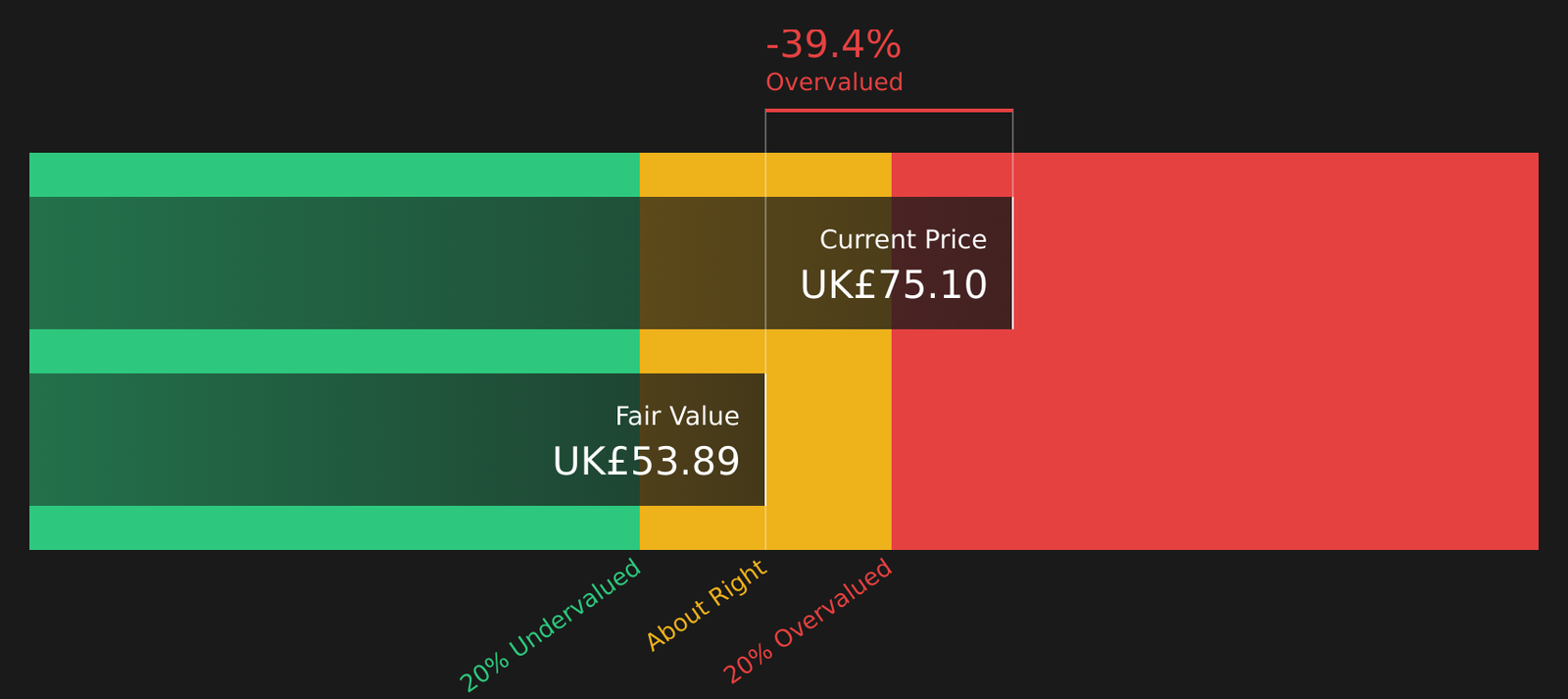
    Based on these projections, the DCF model estimates an intrinsic value of £53.89 per share. When measured against current market prices, this suggests the stock may be overvalued by approximately 39.4%. Despite a robust performance in copper earnings and improved free cash flow this year, the market valuation remains detached from the levels suggested by this cash flow-based methodology.

    Earnings Multiples Paint a Different Picture

    While the DCF model signals caution, the Price-to-Earnings (P/E) ratio offers a contrasting perspective. Rio Tinto currently trades at a P/E of 13.6x, trailing the Metals and Mining industry average of 14.5x and significantly lower than the broader peer group average of 31.2x.

    When compared to a tailored “fair” P/E estimate of 19.2x—which accounts for the company’s specific earnings profile, size, and sector-related risks—Rio Tinto appears to be trading at a discount. This discrepancy persists even after accounting for recent earnings contributions from copper and other operational segments.

    Market Sentiment and Future Outlook

    The divergence between the DCF results and P/E multiples reflects the broader market debate surrounding Rio Tinto. Investors remain split: one faction emphasizes the long-term potential of electrification and green energy transition, while others remain focused on the inherent risks associated with iron ore dependency and rising operational costs.

    Ultimately, the investment case for Rio Tinto hinges on whether the company’s capital-heavy projects can generate sufficiently reliable future cash flows to justify current earnings premiums. As the valuation metrics remain mixed, the central question for shareholders is whether the market is currently pricing in future growth or if the recent rally has outpaced the underlying fundamental reality.

  • Is Green Plains (GPRE) Undervalued After a 71% Surge?

    Is Green Plains (GPRE) Undervalued After a 71% Surge?

    Green Plains (GPRE) shares currently trade at approximately US$15.09, maintaining an attractive valuation despite delivering a robust 70.8% return over the past twelve months, raising questions about whether the market has fully priced in its growth potential.

    Evaluating Green Plains’ Market Position

    Investors are currently scrutinizing whether Green Plains still offers a clear margin of safety following its significant annual rally. While a 70.8% return typically signals a mature growth phase, the company’s valuation metrics suggest there may still be room for upside when compared to broader industry standards.

    P/E Ratio Analysis: A Value Play?

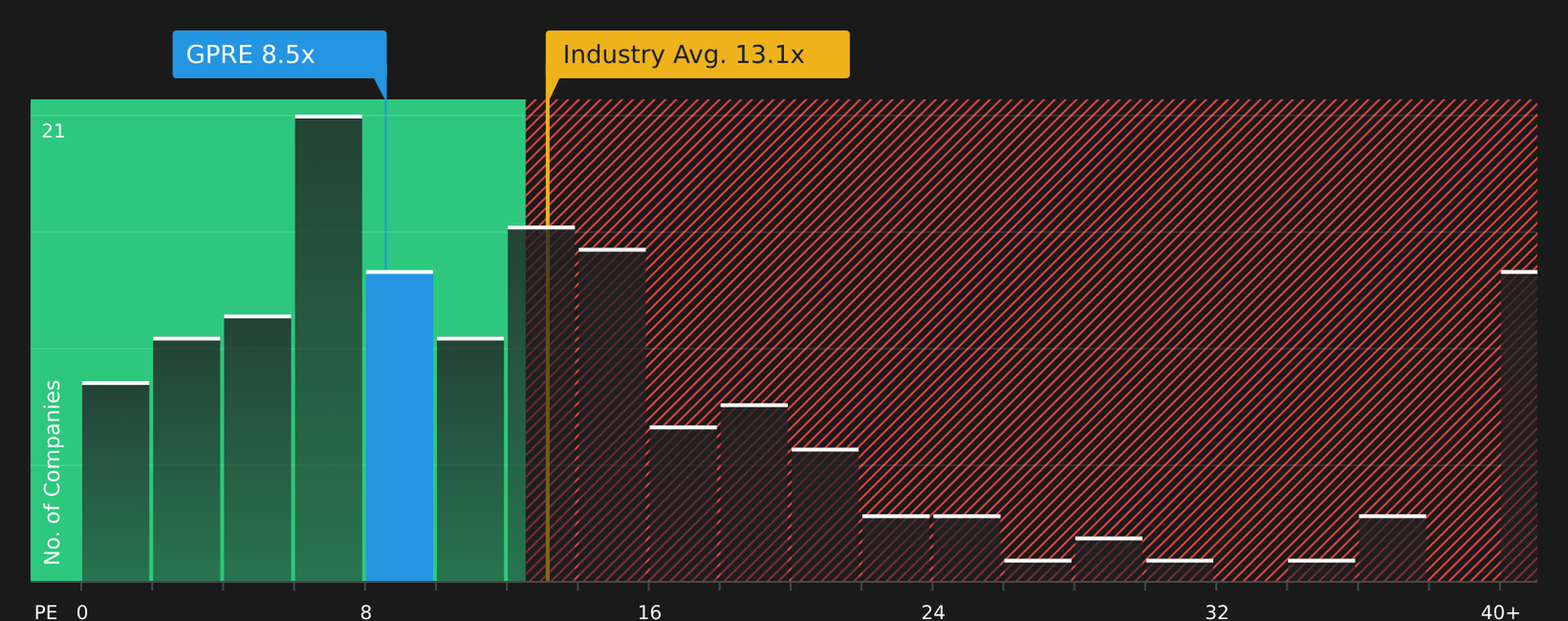
    A primary indicator of the company’s current standing is its price-to-earnings (P/E) ratio. Green Plains is currently trading at a P/E of approximately 8.5x. This figure sits notably lower than the Oil and Gas industry average of roughly 13.1x and significantly below the peer group average of 20.8x. Based on these headline numbers, the stock appears to be priced more conservatively than many of its direct competitors.

    The Tailored Fair Value Benchmark

    When applying a more nuanced framework—one that accounts for the company’s specific size, risk profile, and earnings characteristics—a fair P/E ratio for Green Plains emerges closer to 10.3x. Against this benchmark, the current 8.5x multiple suggests the market is applying a discount to the stock. This gap indicates that Green Plains remains attractively valued on an earnings basis, even after its recent share price appreciation.

    Market Sentiment and Future Outlook

    Investor sentiment regarding Green Plains remains divided. One camp focuses on the company’s earnings potential supported by current industry policies, while the other remains cautious, citing long-term demand risks associated with the ethanol market.

    The core question for investors moving forward is whether Green Plains can successfully transition its business model into consistent, long-term earnings and cash flow. The current discount may reflect market caution regarding policy shifts and long-term demand, yet the fundamental valuation metrics suggest the stock is far from being overstretched.

  • Stocks Surge as Jobs Report Triggers Rate Cut Hopes

    Stocks Surge as Jobs Report Triggers Rate Cut Hopes

    Major stocks rallied in after-market trading following a surprise July jobs report that revealed a loss of 23,000 jobs, significantly missing the 80,000-gain forecast by economists. With the U.S. Bureau of Labor Statistics confirming the unemployment rate remains at 4.1%, the cooling labor market has ignited investor optimism regarding potential Federal Reserve interest rate cuts.

    The “Bad News is Good News” Market Dynamic

    The market’s reaction follows the classic “bad news is good news” logic. As the economy shows signs of slowing, investors are betting that the Federal Reserve will shift away from restrictive monetary policy to stimulate growth. Lower interest rates generally reduce borrowing costs for corporations and boost the relative appeal of equity investments, prompting a surge in market activity.

    While the stock market is prone to overreaction, these volatile periods often highlight significant entry points for high-quality assets.

    Onterris Shares Face Heightened Volatility

    Among the companies feeling the impact of the latest economic data is Onterris. The stock is known for its extreme volatility, having recorded 31 moves greater than 5% over the past year. However, the current price action stands out as an outlier, signaling that the latest jobs report has drastically altered the market’s perception of the company’s valuation.

    Onterris is currently down 30.1% year-to-date. Trading at $17.39 per share, the stock sits 44% below its 52-week high of $31.06, reached in August 2025. The long-term performance remains challenging for shareholders; an investment of $1,000 in Onterris five years ago would currently be valued at approximately $347.23.

  • Plexus Q3 2026: Record Revenue and Bullish 2027 Outlook

    Plexus Q3 2026: Record Revenue and Bullish 2027 Outlook

    Plexus Corp. (PLXS) reported record-breaking revenue in its fiscal third quarter of 2026, fueled by surging demand across its market sectors and the successful launch of multiple new programs. During the earnings call held this week, CEO Todd Kelsey and CFO David Abuhl confirmed that the company is positioned to deliver over 20% revenue growth for the full fiscal year 2026, with a strong momentum carrying into 2027.

    Operational Resilience and Financial Milestones

    Despite a recent tornado impacting the community near its corporate headquarters, Plexus reported no material damage to its operations. The company delivered a robust 6.3% non-GAAP operating margin in Q3, meeting the high end of its guidance. Revenue reached $1.305 billion, a 12% sequential increase and a 28% year-over-year jump. Additionally, the company achieved its best cash cycle performance in over five years.

    Market Sector Performance

    Plexus continues to see broad-based success across its three core pillars:

    • Aerospace and Defense: Revenue grew 10% sequentially, with $135 million in new program wins during the quarter. The company expects growth in this sector to exceed 20% for fiscal 2026.
    • Healthcare/Life Sciences: Revenue rose 2% sequentially, driven by surgical robotics and next-generation ultrasound platform production.
    • Industrial: This sector saw a significant 23% sequential revenue increase, bolstered by new partnerships in data center battery energy storage systems and semiconductor capital equipment.

    Record Funnel and Future Growth Strategy

    The company’s funnel of qualified manufacturing opportunities reached a record $4.5 billion, signaling sustainable long-term growth. Plexus is actively expanding capacity at its Penang, Malaysia facility to support this trajectory. Management expressed high confidence in exceeding their long-term 9% to 12% annual revenue growth target for fiscal 2027, driven by market share gains and leadership in disruptive technologies.

    Guidance for Fiscal Q4 2026

    Looking ahead to the fourth quarter, Plexus anticipates:

    • Revenue: $1.33 billion to $1.38 billion.
    • Non-GAAP Operating Margin: 6.1% to 6.5%.
    • Non-GAAP EPS: $2.47 to $2.63.

    The company remains focused on maintaining disciplined working capital efficiency and expects a return to meaningful free cash flow generation exceeding $100 million in fiscal 2027. By leveraging a campus-based manufacturing model and strategic investments in talent and technology, Plexus is positioning itself to scale as an $8 billion to $10 billion revenue company in the coming years.

  • CPKC Posts Record Q2 2026: Double-Digit Growth and Expansion

    CPKC Posts Record Q2 2026: Double-Digit Growth and Expansion

    CPKC (Canadian Pacific Kansas City) delivered a robust financial performance in the second quarter of 2026, reporting a 13% increase in both revenue and earnings per share ($1.27), fueled by a 4% rise in total volume. The results, announced on Wednesday, July 29, 2026, underscore the strategic success of the only single-line rail network connecting Canada, the U.S., and Mexico.

    Operational Excellence and Network Integration

    President and CEO Keith Creel credited the company’s 20,000-strong workforce for the strong quarter, noting that the integration of the U.S. and Canadian operating systems has created a more fluid and efficient network. Operationally, CPKC achieved new records in asset utilization, train velocity, and terminal fluidity. The company reported an operating ratio of 61.6%, maintaining a disciplined approach to cost management despite inflationary pressures.

    Record-Breaking Growth Across Key Sectors

    The company saw historic volume records in several critical categories, including grain, energy, chemicals, plastics, and automotive. Executive Vice President John Brooks highlighted that the CPKC “land bridge” connecting Mexico and Canada is a unique value proposition that continues to simplify supply chains for customers. Notable developments include:

    • Grain: Revenue surged 24% on a 19% volume increase, supported by strong demand into Mexico.
    • Automotive: Achieved another record quarter with 19% revenue growth and 8% higher volumes.
    • Intermodal: Revenue rose 11%, bolstered by the early success of the enhanced Southeast Mexico Express (SMX) service in partnership with CSX.

    Strategic Investments and Future Outlook

    CPKC continues to modernize its fleet to support long-term efficiency. Mark Redd, Executive Vice President and COO, confirmed the arrival of 70 new Wabtec locomotives in 2026, building upon the 100 units received last year. These investments are critical for network reliability and supporting the robust commercial pipeline expected for the second half of the year.

    Looking ahead, the company maintains a positive outlook for the remainder of 2026. Despite macroeconomic uncertainties, the management team remains confident in delivering double-digit earnings growth for the full year, driven by synergy realization and a growing pipeline of new business opportunities.

    Competitive Landscape and Market Dynamics

    During the Q&A session, Keith Creel addressed questions regarding industry consolidation, specifically the proposed transactions involving Union Pacific (UP) and Norfolk Southern (NS), as well as agreements with Canadian National (CN). Creel maintained a firm stance against further industry consolidation, emphasizing the risks of creating “too big to fail” entities. He reiterated that CPKC is well-positioned to compete regardless of the regulatory outcome, leveraging its unique, single-line North American network.

    Nadeem Velani, CFO, noted that with sequential improvements in revenue and a disciplined approach to capital, the company is well-prepared to achieve its full-year guidance and continue providing sustainable long-term value to shareholders.

  • Jamie Dimon Warns AI Spending Could Keep Inflation High

    Jamie Dimon Warns AI Spending Could Keep Inflation High

    JPMorgan CEO Jamie Dimon is cautioning investors that persistent, heavy capital expenditure on artificial intelligence may prevent inflation from cooling, potentially forcing the Federal Reserve to keep interest rates elevated.

    The AI Capital Demand Dilemma

    While many market participants are betting on a cycle of inevitable interest rate cuts to stimulate economic growth and boost equity markets, Dimon sees a different reality. The massive influx of capital into AI data centers by major tech firms is driving significant demand for resources. According to Dimon, this insatiable appetite for capital acts as a structural force that could keep inflation anchored above the Federal Reserve’s 2% target.

    In a recent interview with CNBC, the JPMorgan chief emphasized that inflation is driven not just by consumer expectations, but by raw capital demand. With tech giants pouring billions into infrastructure to secure their positions in the next growth wave, this spending spree may complicate the Fed’s ability to ease monetary policy.

    Risks to the S&P 500

    The prospect of “higher for longer” interest rates poses a direct challenge to the current market rally. The S&P 500 (SNPINDEX: ^GSPC) has enjoyed a period of remarkable performance, but if the market’s expectation for rate cuts fades, investor sentiment could shift rapidly. Should the Fed choose to hold rates steady or—in a worst-case scenario—hike them further, the market may face a significant pullback.

    Although current interest rates have retreated from their 2022 peaks, they remain significantly higher than the ultra-low levels seen in previous years. If the economy fails to receive the expected boost from monetary easing, the risk of a market correction or a more pronounced downturn increases.

    Strategic Diversification in a Volatile Climate

    With the S&P 500 on track to deliver above-average returns for a fourth consecutive year, current market conditions suggest a need for caution. Investors may find it prudent to reassess their portfolios and prioritize defensive assets to mitigate potential volatility.

    Shifting capital toward value-oriented investments and defensive stocks is a strategy that can help maintain market exposure while reducing overall risk. As economic uncertainty lingers, diversifying holdings may serve as an essential hedge against the possibility of a market contraction prompted by persistent inflationary pressures.

  • Iren SpA Q2 2026 Earnings: Hydro Challenges and Outlook

    Iren SpA Q2 2026 Earnings: Hydro Challenges and Outlook

    Iren SpA (IRDEF) addressed key operational adjustments during its Q2 2026 earnings call, citing reduced hydroelectric production as the primary driver for a revised annual guidance. Executive Chairman Luca Dal Fabbro and CFO Giovanni Gazza outlined how lower reservoir levels necessitated a production cut from 1.2 TWH to 1.05 TWH, creating an EBITDA impact of approximately EUR 18 million that the company is actively offsetting through network business growth.

    Hydroelectric Headwinds and Strategic Adjustments

    The guidance update is strictly tied to hydroelectric output. Luca Dal Fabbro clarified that while the EUR 18 million EBITDA reduction is significant, it is being mitigated by a robust recovery in the network business unit. Regarding the broader regulatory landscape, the company is currently engaging with the Italian government to gain clarity on hydroelectric generation frameworks, particularly concerning autonomous processes in Trent, Bolzano, Emilia, Lombardia, and Piedmont.

    Financial Hedging and Market Positioning

    CFO Giovanni Gazza provided a granular look at the company’s hedging strategy. For 2026, 80% of renewable production is covered at roughly EUR 105 per GWH. Looking further ahead to 2027, Iren has secured approximately 50% of its forecasted 2,150 GWH renewable output at EUR 100 per MWH, with plans to reach 70-80% coverage as market conditions evolve.

    Customer Churn and Supply Business Dynamics

    The market supply business continues to face a competitive environment, with the full-year churn rate holding steady between 25% and 27%. The company reported a shift in its customer mix, now comprising 32% fixed-price contracts and 68% variable-price contracts. Management expects a loss of roughly 40,000 customers in the second half of the year, a result of a highly selective commercial policy aimed at maintaining margin quality.

    Waste Management and Network Performance

    Addressing the waste business, Giovanni Gazza noted that first-half results were hampered by a non-replicable EUR 60 million one-off event. Moving forward, the company anticipates margin recovery, supported by operational improvements at the Port de Bonoi and Turing sites, alongside contributions from new landfills like CSAI and Barricala. Simultaneously, the network business is expected to maintain positive momentum, building on the EUR 10 million in organic growth and EUR 11 million in synergies achieved in the first semester.

    Future Growth: Data Centers and Regulatory Outlook

    On the topic of data centers, Iren is actively negotiating business models focused on shared savings in energy transportation costs rather than equity-based partnerships. These initiatives are expected to be incorporated into future plans once agreements are finalized next year. Furthermore, the company confirmed that its net profit guidance of up 2% accounts for all IRAP effects related to recent energy bill decrees, maintaining consistency with projections established in May.

  • Stock Futures Rise as U.S.-Iran Deal Hopes Ease Oil Fears

    Stock Futures Rise as U.S.-Iran Deal Hopes Ease Oil Fears

    U.S. stock index futures climbed this Tuesday as market sentiment improved on reports that the U.S. and Iran are nearing a diplomatic arrangement, effectively cooling oil prices. S&P 500 E-Mini futures (ESU26) gained +0.19%, while Nasdaq 100 E-Mini futures (NQU26) rose +0.31% in early trading.

    Diplomatic Hopes Stabilize Energy Markets

    The shift in market tone followed remarks from Pakistan’s defense minister, Khawaja Asif, who indicated that recent signals suggest both nations are close to a deal. This development helped stabilize WTI crude prices, which had previously surged over +2% after President Donald Trump issued new, aggressive demands regarding reparations for historical conflicts and casualties involving Iran.

    Wall Street’s Mixed Performance and Sector Shifts

    The rally follows a challenging session on Wall Street where major indexes closed lower. The tech sector faced significant pressure, with Arm Holdings (ARM) and Marvel Technology (MRVL) sliding -5% and -4%, respectively. Optical-networking stocks also struggled, as Coherent (COHR) plummeted over -14% and Lumentum Holdings (LITE) fell more than -8%. Nvidia (NVDA) dipped over -2% amid news of a potential $500 billion AI infrastructure funding partnership involving major U.S. investment firms. Conversely, energy stocks like APA Corp. (APA) and Marathon Petroleum (MPC) saw sharp gains, rising +9% and +7% respectively on the back of higher oil prices.

    The Fed’s Stance and Economic Outlook

    Cleveland Fed President Beth Hammack signaled on Monday that multiple interest rate hikes may be necessary to hit the 2% inflation target, noting that current rates are not yet “meaningfully restricting” the economy. Market participants are currently pricing in a 51.9% probability of a 25-basis-point rate hike at the upcoming policy meeting. Investors are now shifting their focus toward the National Association of Realtors’ existing home sales report, with expectations set for 4.05 million units in July, and Wednesday’s crucial consumer inflation report, which could dictate the Federal Reserve’s future trajectory.

    Global Markets and Corporate Movers

    In Europe, the Euro Stoxx 50 Index remained largely flat as traders weighed fuel cost concerns against gains in the energy and tech sectors. Meanwhile, in pre-market activity, Riot Platforms (RIOT) surged more than +16% following a 20-year deal to supply power to an AI firm, reportedly Anthropic. Conversely, Upwork (UPWK) dropped over -19% after slashing its full-year guidance, and Hims & Hers Health (HIMS) fell more than -4% following wider-than-expected quarterly losses.

    Upcoming Earnings Spotlight

    Investors remain focused on a busy earnings calendar today, featuring reports from key players such as Super Micro Computer (SMCI), Lumentum Holdings (LITE), CoreWeave (CRWV), CAVA Group (CAVA), and H&R Block (HRB), among many others.

  • Is BeOne Medicines (ONC) Undervalued After Earnings Beat?

    Is BeOne Medicines (ONC) Undervalued After Earnings Beat?

    BeOne Medicines (ONC) outperformed analyst expectations in its second-quarter 2026 results released on August 5, prompting the company to raise its full-year 2026 guidance amid a steady climb in share price.

    Market Performance and Investor Sentiment

    The company’s latest financial performance arrives as the stock maintains positive momentum, having gained 6.8% over the past month and 6.0% year-to-date. Furthermore, a 66.6% total shareholder return over the last three years underscores sustained investor confidence in the firm’s long-term trajectory.

    Valuation: Is There Still Upside?

    With the stock closing recently at $329.80, investors are currently weighing whether to increase their exposure or await a potential pullback. Current market analysis places the fair value of BeOne Medicines at approximately $412.35 per share. This suggests the stock is trading at a material discount, even while accounting for the company’s aggressive growth and profitability targets.

    The Path to Future Profitability

    The bullish case for BeOne Medicines rests on a specific set of projections: high revenue expectations, expanding margins, and a disciplined path toward future cash flows. For the current valuation to hold, these operational pillars must align with significant precision.

    Key Risks and Competitive Pressures

    Despite the optimistic outlook, the investment thesis faces potential headwinds. The narrative could shift rapidly if flagship products, such as BRUKINSA or sonrotoclax, underperform against market competitors. Additionally, external pressures related to drug pricing and evolving regulatory requirements could compress profit margins.

    P/E Ratio and Market Expectations

    While fundamental fair value models suggest the stock is undervalued, the current P/E ratio presents a different picture. BeOne Medicines trades at a P/E of 57.2x, significantly higher than the industry average of 17.1x for US biotechs and the 26.5x seen among peers. This premium indicates that the market is already pricing in a high degree of confidence in the company’s future execution. The critical question for investors remains whether this premium is justified by the company’s long-term growth potential.

  • Lojas Quero-Quero Q2 2026: Resilient Growth and Strategy

    Lojas Quero-Quero Q2 2026: Resilient Growth and Strategy

    Lojas Quero-Quero (BSP:LJQQ3) reported resilient growth and strategic expansion during its Q2 2026 earnings call, navigating a challenging macroeconomic landscape through disciplined cost management, a focus on small-market dominance, and a conservative credit approach.

    Market Share and World Cup Impact

    Despite the global attention on the World Cup, the impact on Lojas Quero-Quero’s sales was marginal. While television sales saw a slight uptick, the overall effect on the company’s performance was not significant. Management confirmed that the company successfully gained market share during the period and intends to maintain this momentum despite broader market volatility.

    Margins, Sales Growth, and Outlook

    The CFO addressed concerns regarding gross margin variations, noting that the second quarter performed differently than the first due to seasonal factors. While same-store sales growth is expected to remain positive, management acknowledges inherent volatility. The third quarter is historically softer, but the company maintains its current guidance and anticipates a stronger sales performance as the year progresses.

    Path to Profitability and Cash Flow

    Lojas Quero-Quero consumed cash during the first half of the year, a trend attributed to typical seasonality. However, the company projects a return to cash generation by the fourth quarter. If sales trends continue to improve throughout the second half, the company remains optimistic about returning to positive net income, provided that working capital remains under strict control and leverage stays within improved historical levels.

    Credit Portfolio and Risk Management

    In a cautious economic climate, the company’s credit portfolio grew by 3% in Q2, with a primary focus on quality over aggressive expansion. Demand for credit remains stable, and delinquency rates are well-controlled. By maintaining a conservative credit policy, Lojas Quero-Quero aims to ensure long-term sustainability and is prepared to scale its financial services as the macroeconomic environment stabilizes.

    Expansion Strategy and Operational Efficiency

    A cornerstone of the company’s growth remains its expansion into smaller municipalities. In the first half of the year, Lojas Quero-Quero opened 6 new stores in cities with populations between 20,000 and 50,000. This strategy solidifies its leadership in the interior of Brazil. Simultaneously, the company has kept operating expenses stable, with nominal growth virtually unchanged compared to the previous year, demonstrating high efficiency in cost structure management.

    Driving Performance: Categories and Initiatives

    Same-store sales have shown consistent growth of approximately 8%, with the construction materials segment standing out as a primary driver. Initiatives such as the new store format and the “Mais” program have significantly improved customer experience, contributing to positive results across most product categories. Moving forward, the company’s priorities remain anchored in disciplined operational growth, rigorous cash flow management, and the maintenance of a high-quality credit portfolio to maximize shareholder value.